Saturday, February 27, 2016

Road to Portfolio

Hello bloggers!

Firstly, I would like to thank everyone who took the time to read and comment on my stories. It was greatly appreciated. I realized that even though creating stories about our readings can be interesting what I enjoy the most is being able to produce totally random themes and plots for my stories. In a way I actually enjoy that the plots do not have to be connected but rather they can exist in their own unique universe. As we are near the end of the semester I hope that at least one of the two stories below added positively to your experience in this course.

Week 3: "In Dark Corners"
This story revolves around a mysterious murder in the king's castle and his search for answers.

Week 4: "Close Encounters"
While searching for adventure, a boy stumbles upon a peculiar tree in the forest.

Thursday, February 25, 2016

Week 6: Reading Diary

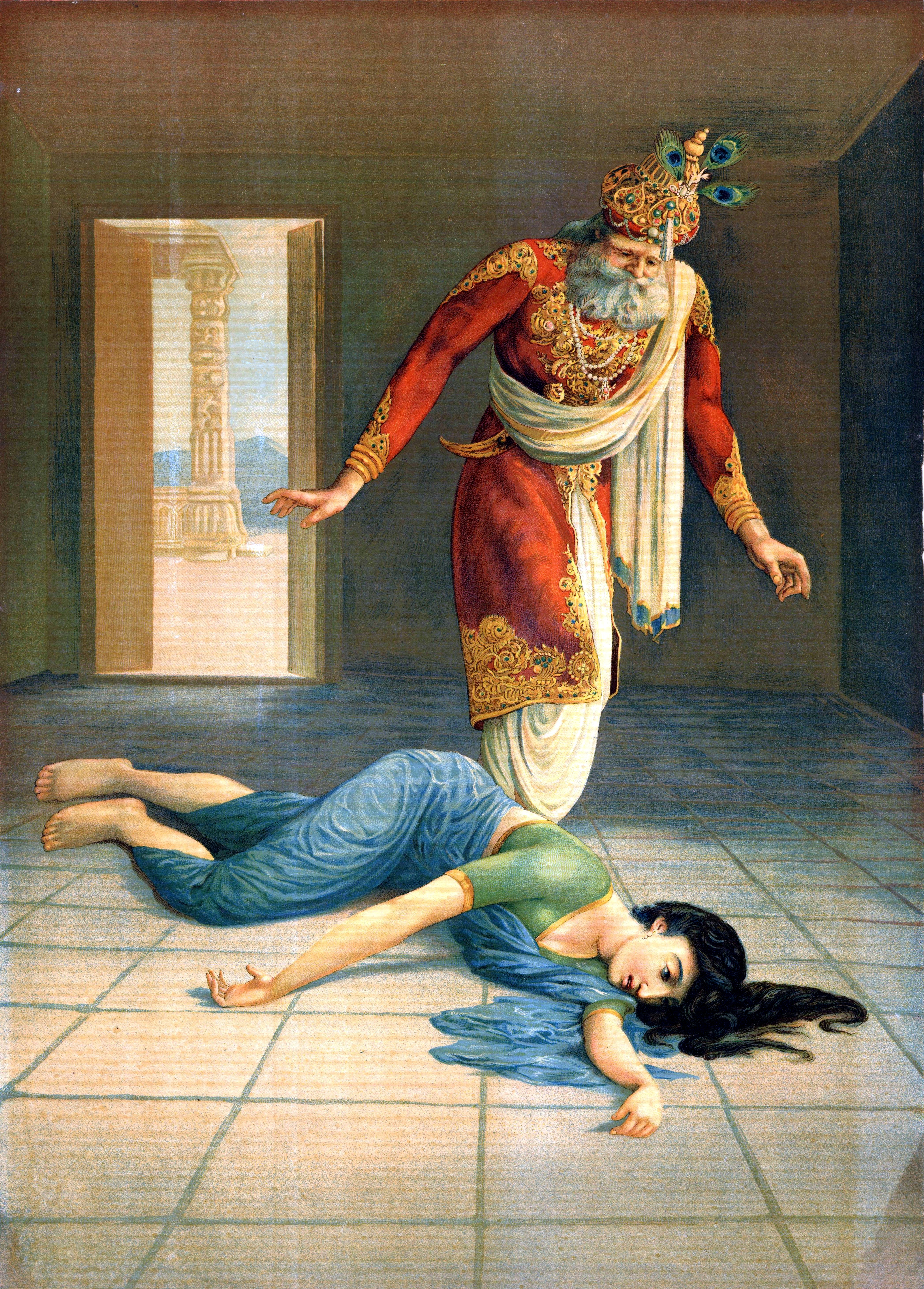
In studying the conflict between the Pandavas and the Kauravas, the king Dhritarashtra may be identified as a major source of turmoil for the Pandavas.
Even though he is caring and considerate of his nephews, he cannot overcome his bond with the "jackal"  ,Duryodhana, who coerces him into making reprehensible decisions. This prince displays such a ferocious contempt for the Pandavas that he continuously plots for their humiliation and demise. His plans are executed in the midst of the king without reproach due to Dhritarashtra's inability to take a firm stance with his own son. Duryodhana's actions seem to propel his kingdom further into a state of depravity.

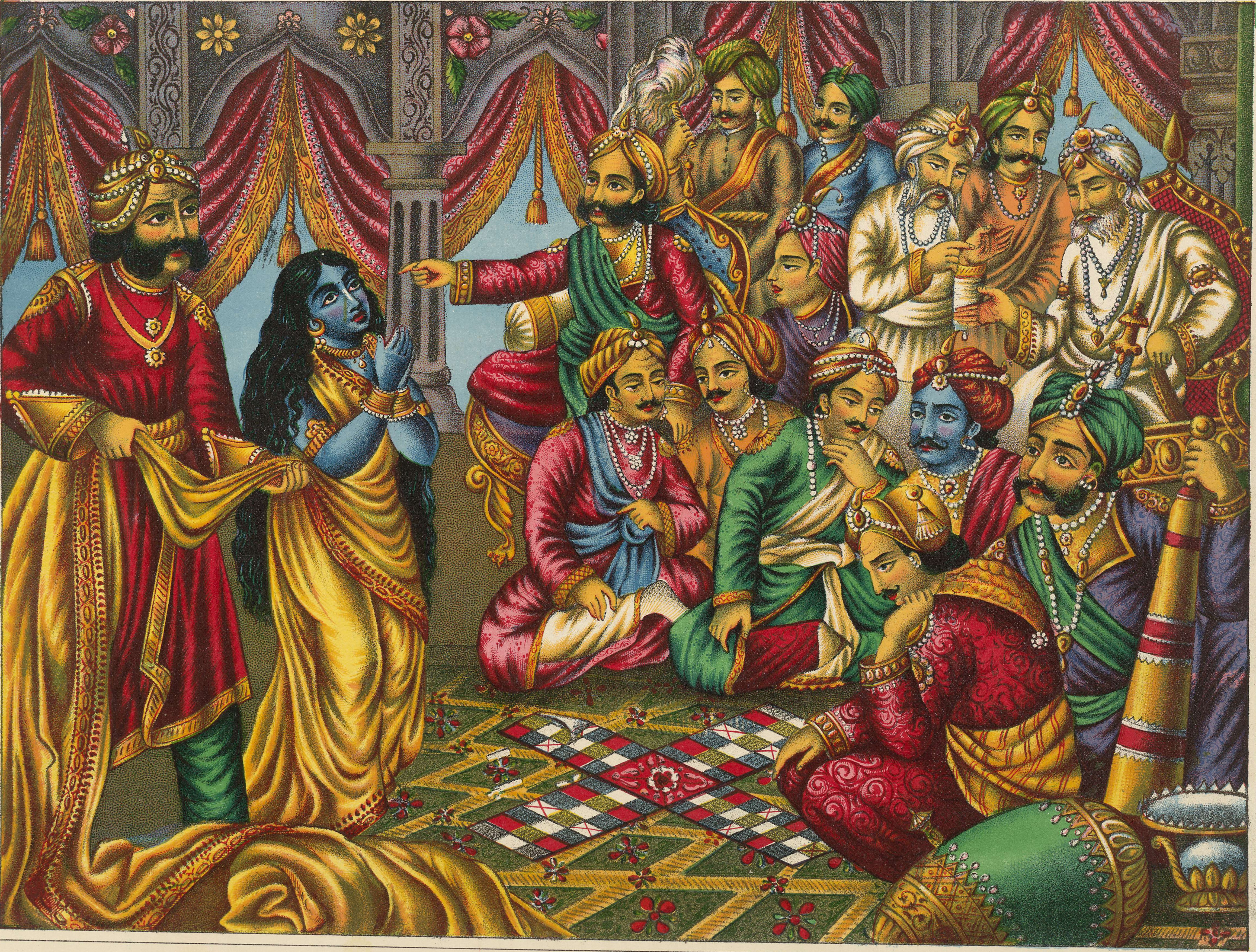
(Draupadi declared as stake and lost by  Yudhishthira)


Arguably, some of the plots set by Duryodhana would not have been successful if not for the foolishness of the Pandavas. The reader may observe the gambling debts that are incurred by the king
Yudhishthira not once but twice. Some may argue that Yudhishthira does not incur these losses out of foolish pride but due to his promise never to make decisions that divide people. This coupled with his sense of obedience to his uncle may be seen as a more likely reason for the events that unfold surrounding his decision to gamble.

Monday, February 22, 2016

Week 5 Reading Diary : Feuding

The main themes within the Mahabharata include family feuds and corruption. When the Pandavas are encouraged to leave the city for a relaxing family vacation of sorts, the trip turns out to be a plot by the Kaurava to murder their own family members so that there will be no contest for the throne. With the Pandavas dead the notoriety will remain with the Kaurava princes. We see here how the lust for power coupled with envy of others is able to twist one's mind.

(The Pandavas escaping the burning house.)

Although the Pandavas in all their greatness are often described as being unfair in their treatment of their cousins. The relationship dynamic between the Pandavas and the Kauravas does well to examine the question of morality and what makes up a characteristics of a righteous person. Is it enough to be born into royalty like the Kauratas and Pandavas? Or must one inherit otherworldly skill and prominence? All these seem to indicate some level of greatness and yet none are directly linked to righteousness.

Week 5 Review

One weekly announcement that caught my attention is the Growth Mindset post about embracing challenges. I am familiar with Dr. Dweck's work with children in fostering healthy learning experiences. However, this post resonates with me during this week in particular. I have been placed in positions of responsibility and leadership throughout the semester. From team projects to my management position at work, I have openly accepted such roles And even though the challenges sometimes seem overwhelming I try to remind myself that what I am trying to accomplish now is more worthwhile than simply avoiding the trouble and doing enough just to get by with school or work.
(Carol Dweck's growth mindset at work!)

Week 5: Famous Last Words

This week I did not do a storytelling assignment. Oddly, it was a bit more difficult for me to focus my thoughts and start writing in the same way that I did in the past. I am hoping that it was due to a time constraint. I do not want to believe that I have just run out of ideas for satisfying stories with so much left to do in the course.
Instead I spent a significant amount of time editing the first story that I wrote following Week 2, "In Dark Corners." I enjoyed writing this story. Even though it may not be perfect I am proud of this work. Typically, I do not see myself as a talented writer much less a storyteller. I watch a lot of movies and read a couple books a year. But that hardly qualifies someone as being a good storyteller. Writing these stories and receiving positive feedback from my peers reminds me of when I first started sketching. I had never had much of a talent for art as a kid. But somehow I just felt motivated to see what my work would look like if I decided to pick up a pencil. And surprisingly I was satisfied with the end result(not always but I made progress).
(How do you see the glass?)

Sometimes I think that I can't keep up with this course. But not because it is unreasonable in its deadlines but because of my weekly schedule and study habits. Even so I enjoy the class and try to stay optimistic. In spite of the work that I missed during Week 2 when I got sick I have been able to catch up by completing the extra credit assignments. I wish that all of my classes would have extra credit assignments that I could do when the regular work got too hectic or I missed a deadline.

Tech Tip: Reverse Image Search

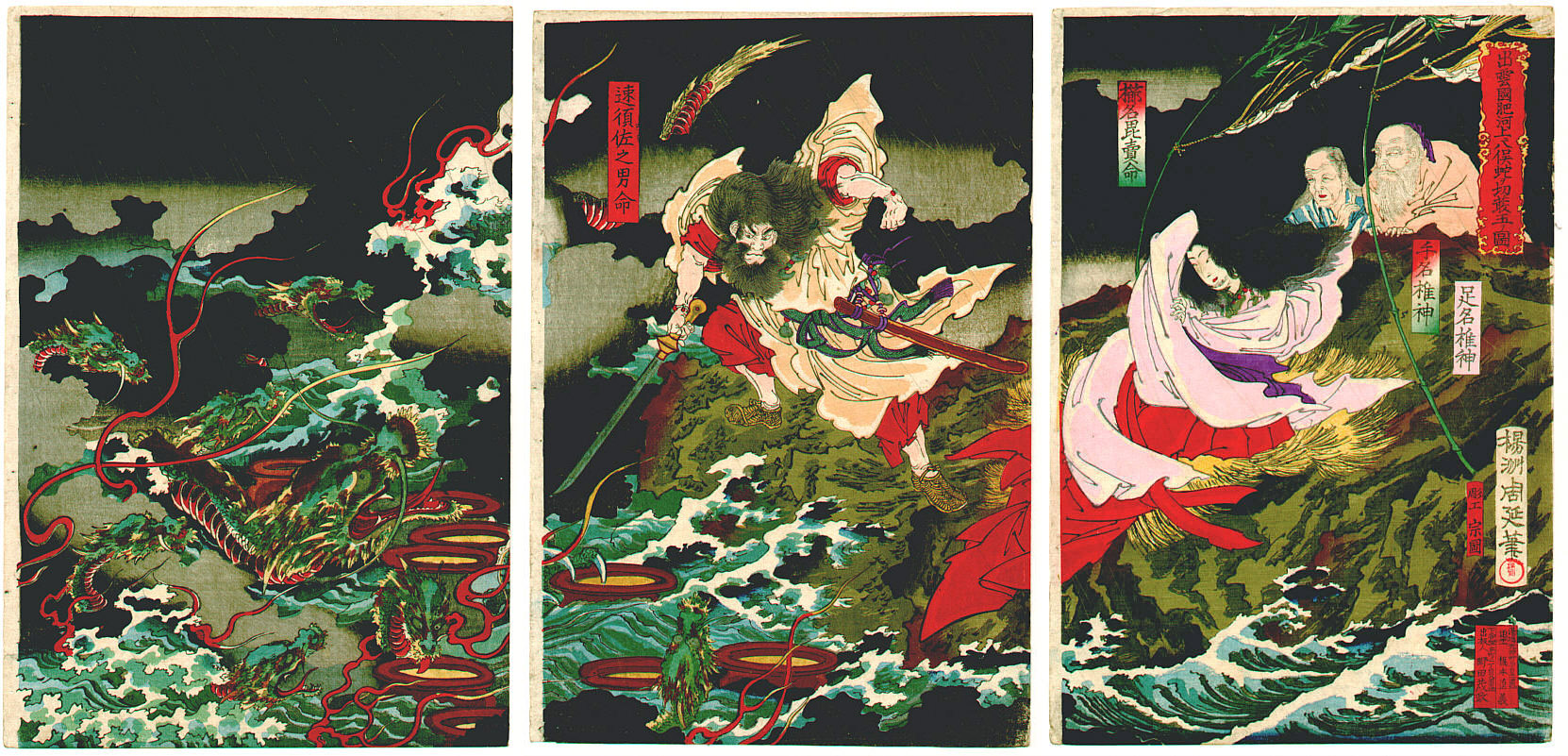
For my reverse image search I used the picture of Susanoo slaying the Yamata no Orochi, by Toyohara Chikanobu. This artwork represents a part of Shinto religion in Japan. The storm-god Susanoo is seen defeating the Japanese dragon Orochi.
(Susanoo slaying the Yamata no Orochi, by Toyohara Chikanobu)

Thoughts about Comments

I have been mostly satisfied with the comments posted about how I can improve my writing. However, at times some comments seem a bit vague. For example a fellow blogger might identify a period during my story in which they were confused about the plot or dialogue (which I admit often needs work). But I think that offering their perspective on how they would structure certain lines that they find peculiar would be most helpful. That way I am not only identifying a problem with my writing but also implementing a solution almost immediately after the comment is read.
I am certainly not asking anyone to rewrite my entire story for me, but I think this method would help each of us to avoid repeating our errors in later stories.

(Fountain pen)

At the same time, I admit to posting a few vague comments of my own. I will also work on providing more sound and constructive criticism to help others improve as well.

Week 5 Comment Wall

I would like to express my gratitude for everyone who provided helpful feedback to my stories. But also for those who just wanted to express their satisfaction in reading each story. I appreciate that people took the time to leave thoughtful comments that were not only positive but highly constructive for my development as a writer in the class. I hope that I can also provide some useful insights for others during their learning process.
(How many languages do you recognize?)

Thursday, February 18, 2016

Week 5 Reading Diary: The Mahabharata

What may be quite striking to the reader is the elaborate nature in which the Pandavas are born to queens Kunti and Madri. Through the incantation of mantras that call out to the gods, king Pandu's wives give birth to these five brothers. Comparing these characters to Rama, we see the significance of such godlike figures in both epics as symbols of perfection, hope and even envy for the people surrounding them.

(The Pandavas, made up of the five brothers previously mentioned.)

The idea of half human children reminds me of many tales in Greek mythology. Countless demi-gods are born through the dalliances of gods such as Zeus who, while on earth, typically engage any woman they chose, sometimes even while in the form of other creatures. In a similar fashion to the Mahabharata, many of these half-humans grow to become legendary warriors, a well-known example being Hercules.
Incarnation is still an expected occurrence in this epic, however much attention is given to royal lineage and class systems. The Pandavas are born partly out of a need to establish potential heirs to carry on the succession of the throne. With this, the focus of this narrative seems to be more about the feud between individuals of royal bloodlines rather than the destiny of certain characters to deliver justice to the world, as is the case with Rama's true calling.

Monday, February 15, 2016

Week 4 Review

Reading through the announcements, I noticed one in particular which illuminated the meaning behind the word "Friday". This word finds its origins in Norse mythology from the Goddess of married love, Frigg. This person also happened to be married to Odin. This is particularly interesting when one considers that the word "Thursday" also finds its origins in Norse mythology. I enjoy learning about how a cultures and mythologies that may be considered to be more obscure or less popular were able to influence the world on such a grand scale. Such influences are not limited to the days of the week as everything from our number system, to our units of measurement can be traced back to culturally groups that may seem so different from us.
(The goddess Frigg)

Week 4: Famous Last Words

During this week I was able to finish Narayan's Ramayana. I enjoyed the book thoroughly because of the mythology that was constantly being highlighted throughout the story. Rama is constantly developing relationships with mythical creatures and gods who are often engaged in very "human" tragedies such as familial betrayal and broken hearts. Fantasy stories such as these provide great flexibility for storytelling because the writer can decide how much of the fantasy world and how much realistic drama he/she wants to include in the story.
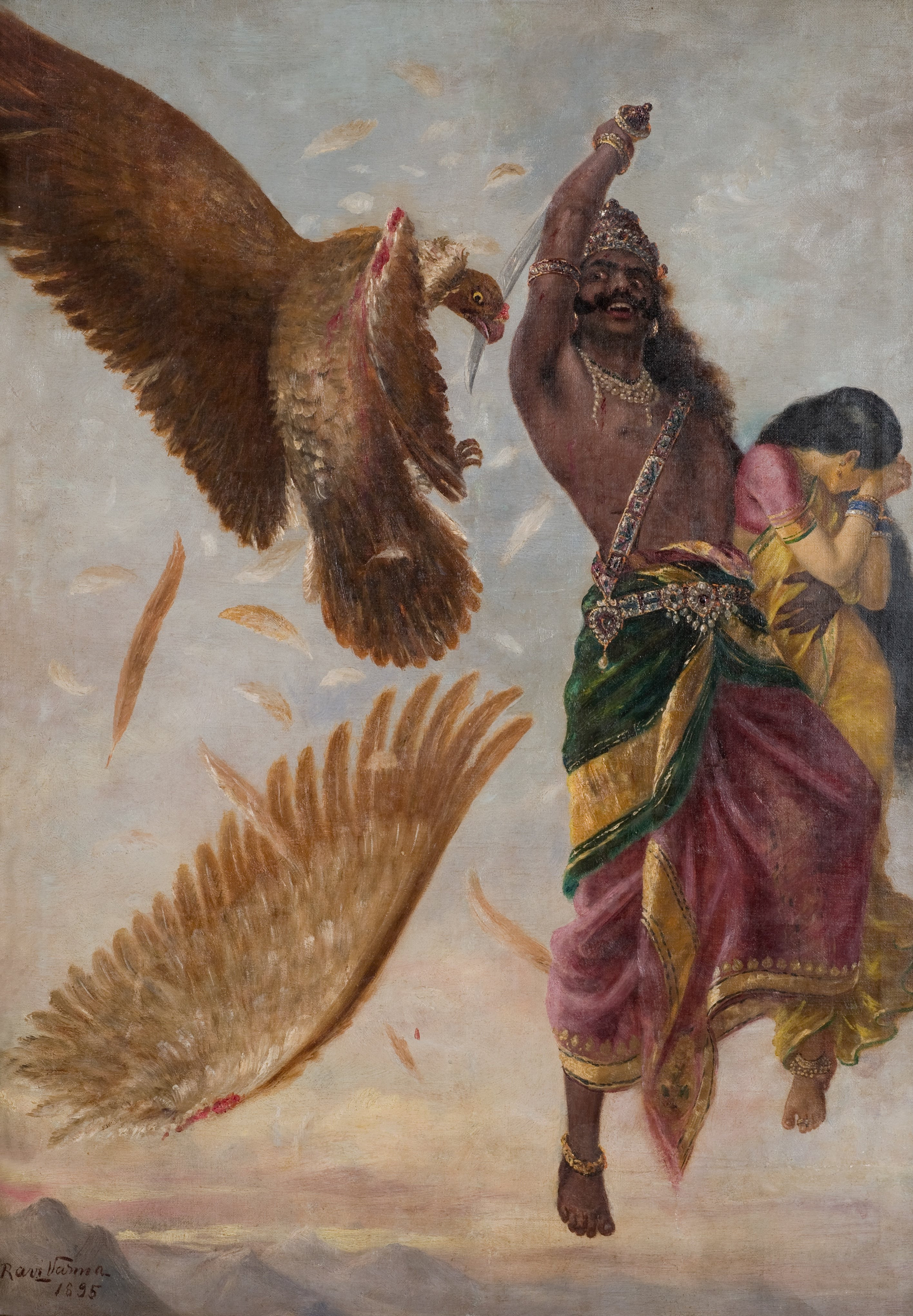
I am very satisfied with my latest storytelling post. It is an origin story for the king Dasaratha, set in a time when we was just a child. Like I mentioned before, creating a children's tale about surviving a monster's cruelty is just one example of the many interpretations that can be made from the original narrative.
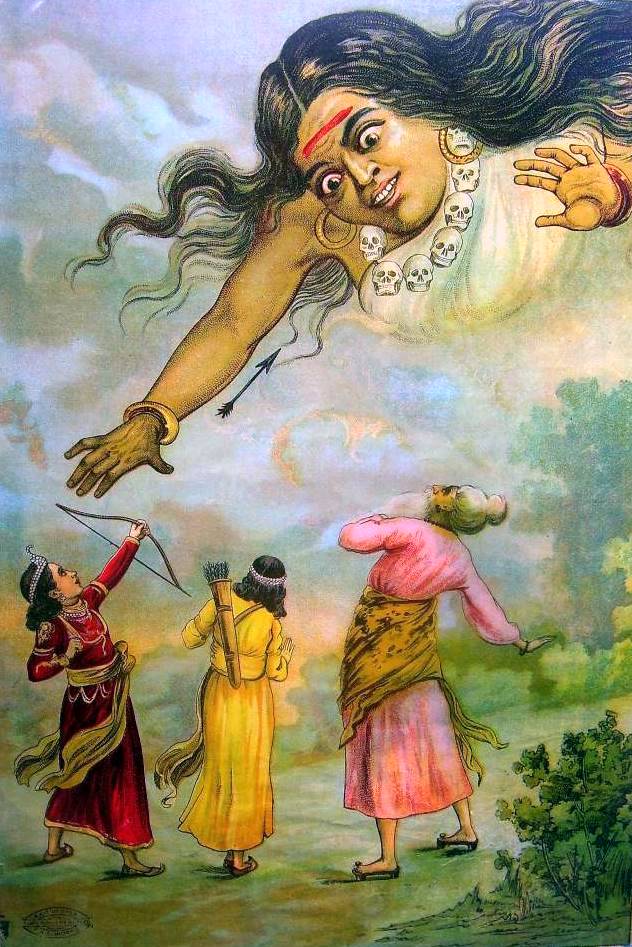
(Jatayu, one of the main characters in my storytelling post, battling Ravana)

One other major milestone for me was my decision to go with the Portfolio project. After considering why exactly I enjoyed writing stories for the readings, it became apparent that the portfolio would give me the creative freedom to produce stories that are less focus on connected plots and more focused on originality.
I have already posted my first story to the portfolio after editing the author’s note. Getting feedback on my stories is something that I look forward to for my storytelling posts so I think that this assignment will fit nicely with my strategy for writing these stories.
Missing so much work in Week 2 was definitely an unfortunate event for me but I am optimistic for the remainder of the semester especially since I am more confident about what my project should be for the remainder of the academic year. After looking at other people’s storybooks and portfolios in the making, the whole process seems a lot more exciting when I think about everything improving and breathing life into their own characters and narratives.

Week 4 Tech Tip: Google Timer

Writing about the Google Timer feature seemed very relevant to me because it was already something that I was doing while using a different timer. As students we can sometimes overestimate the amount of time that we have been doing an assignment, especially if we think that the work is boring. At some point we may convince ourselves that we are already mentally fatigued by the assignment even though only 30 minutes or so have passed.
Timers can help us maintain perspective on how much time should be allocated to studying. If a student spends only 30 minutes of studying for every 3 hours of class that he/she attends then this should be recognized as an area for improvement. If you are just starting out with a timer you can begin with smaller intervals and work your way up to longer periods of study.
Of course this tool can extend to other facets of time management aside from studying. Maybe reading or a hobby can be timed in order to optimize productivity during the day.
(Finding the best balance between work and play is a constant challenge.)

Friday, February 12, 2016

Storytelling Week 4: Close Encounters

Every morning the boy would go climbing on the oldest, largest trees he could find in the forest. It was always so early that the only voices he could hear were the singing of birds and the whistling of leaves as a gentle breeze filled the air. Warm, piercing rays of light would come creeping through the branches.

Preview tree
(The forest where the boy plays every day.)

One morning something odd happened. The boy stumbled across a peculiar tree which stood ominously, enclosed by a field of beautiful flowers. Hesitant at first, the boy gathered his resolve and moved to conquer the tree. He clung to the bark, his hands moving first, then feet, following this rhythm as he moved up the tree. But just as the boy had reached his first branch a terrifying sound erupted.

"You, a mere boy dare to interrupt my slumber!?"

The voice was like a screech that invaded the child's ears and caused such a severe headache that the boy lost control of his grip and fell to the ground. As he lay there writhing in pain, a spider-like creature sped down the tree until its red eyes and fangs, like those of a saber-toothed cat, were but inches from the boy’s face. The creature resembled a human if not for its four arms and legs, covered in thorns. This was a Rakshasa.

"I would eat you right now if not for that wretched stench," howled the beast.

The boy had soiled himself. He remained on the ground shivering uncontrollably as the demon's rancid breath puffed against his face. The child tried to open his mouth to speak, but all that escaped was sobbing. So he closed his eyes and curled up into a ball, quivering in fear. The boy heard yet another screech from the demon.

"Surely, you are blessed by the gods," said the beast, "for I am quite tired today."

"But listen carefully," snarled the Rakshasa. "While you were cowering in fear I, the great Ishnana, placed a curse on you. For whichever tree you attempt to climb will open up and devour you whole."

As Ishnana scurried up the tree, the boy dragged himself in shame as far as he could get from the demon.

During the next few days the child fell into a severe depression. While he sat on a riverbank, a great shadow loomed over him. As he turned around, the child gazed upon a huge vulture descending upon him. The bird moved so quickly that the boy could only shield his face from the strong gust of wind. To the child's surprise the vulture began to speak.

"What has you troubled?" asked the vulture. "I have flown over these woods many times and witnessed you running about gleefully. But today you sit in silence."

With tears in his eyes the boy explained the events that had occurred.

"Dear boy, you are in luck for I know of this creature's weakness," responded the bird.

And so they devised a plan to defeat Ishnana. The boy climbed onto the bird's back and they set off to gather materials for their plan.

Several days later the child cautiously approached Ishnana's tree and called out.

"Oh great one, please allow me to repay you for the mercy that you showed me the other day," declared the child.

The boy stood in silence, anxiously awaiting Ishnana's reply. But there was silence. With a sigh of dismay, the child turned around. But as he was making his way to the riverbank, the tree shook violently. Ishana's thorny limbs scraped and stabbed the tree as he hurried to the ground.

"Not once, but twice you have disturbed me," replied Ishnana in anger. "Explain yourself at once!"

"I noticed that you maintain a beautiful garden," said the child. "But I have found one filled with even more exotic plants."

"Nonsense, there is no such garden in this forest!" shouted Ishnana. "Show me the way and I shall decide for myself!"

The demon did indeed have a weakness for flowers. He collected and planted them tirelessly for his garden. They eventually came before a clearing where the light shone beautifully at its center. And at this point lay a glorious plot of flowers, with colors known only to the Gods.

"Incredible! Some of these flowers cannot be found in this world," said Ishnana as he approached the plot. "How did you discover such a thing?"

But before the creature could hear a response, the ground beneath him crumbled. Ishnana was plunging further and further into a deep pit. At this moment the vulture arrived.

"Jatayu, why have you come here!?" asked Ishnana as he struggled to climb out of the hole. "Is this your doing!?"

"Yes it is I, Jatayu, protector of this forest," said the bird."You have harmed one of my protected creatures and so I sentence you to remain at the bottom of this hole, beneath the flowers you so admire.”

Jatayu then rose up and with two flaps of his wings gathered enough dirt to fill the hole. As Ishnana tried to claw his way out, roots shot out of the inner walls of the pit and like rope restrained the demon. The flowers were indeed otherworldly for they fed on the energy of Rakshasas. Ishnana could only remain there helplessly as the flowers sucked away his life. With the hole sealed, the boy turned to Jatayu in praise.

"Thank you for saving me. I do not deserve such a guardian," said the boy.

"Oh, but few are worthier of protection," responded Jatayu."For I did not appear to you by chance. The gods sent me to protect you. You are to be a great leader. You will nurture a champion among gods, the one who will break Shiva's bow."

"I do not understand," replied the child. "But I hope that we can be friends."

With a look of great joy, the vulture replied, "Surely, we will be brothers."


Author's Note

I was motivated to write this story as sort of an origin to Rama's father. I thought that it would be interesting to know a little more about the great king who had raised so many respected sons. I then remembered his relationship with Jatayu and how it was mentioned that the two characters had had a longstanding relationship with each other before the events of the Ramayana. So creating my own take on his origin story seemed like an interesting idea.

While reading the Ramayana I was under the impression that Jatayu’s relationship with Dasaratha was born out of battles that they had fought together. But rather than create an elaborate battle sequence or political conflict, depicting the intensity of their bond within this plot seemed more effective. This story is more akin to a cautionary tale than a tragic war story. The innocence of the main protagonist in this story contrasts nicely with the Rakshasa and creates a deeper bond between the reader and Dasaratha,who is seen not as an unforgiving and resilient king but as a vulnerable human. Forests are quite often used as metaphors for a character’s growth and triumph over adversity, while the monster often reflects a vice that is common to humanity. Therefore, I believe that I must have been influenced by such plot devices while composing my own work. 

The name of the rakshasa was meant to be an allusion to the character Anansi, who is an icon of West African and Caribbean folklore. I only began thinking of Anansi while I was trying to come up with a name for the demon. But it is possible that Anansi had been influencing my decision to use a spider-like creature from the beginning.

Bibliography:


Thursday, February 11, 2016

Week 4 Reading Diary : Narayan's Ramayana

At the conclusion of Narayan's Ramayana, the reader finds that there is a certain peace and reconciliation that is granted to many of the tormented characters in this narrative.
Ravana's demise is met with a subtle mood of sadness for how far he had fallen from grace. However, Rama still speaks for his rightful place in heaven while conferring proper funeral rights to his brother Vibishana. The mercy shown by Rama may contrast with the earlier, more controversial chapter in which he kills Vali with an arrow through the chest. Even though Rama justifies his actions to a creature that has already committed wrong, his reasoning is described in a manner that may be purposefully meant to elude the understanding of the reader so as to present Rama's reasoning as beyond that of conventional human understanding.
(Sita emerges victorious during her trial by fire.)

This method may be observed once more in Rama's decision to subject Sita to the trial by fire for which he claims is meant to remove all doubt from the world as to her purity. However, Rama's human nature seems, at times, to be at odds with his more godly attributes as stated in the text.It is at this instance that Rama, together with his father are able to find peace in each other's words. Dasaratha's forgiveness of Kaikeyi and her son, together with Rama's accomplishments, delivers to him an inner peace which had eluded him even in heaven. Rama, on the other hand is filled with joy over his father's words of praise and  is content to find that Dasaratha delivers on Rama's wish that he accept Kaikeyi once again as family.
The fate of these three characters - Ravana, Sita and Rama are reconciled in such a way that may be akin to the trinity of Hindu faith. Even Brahman himself comments on Sita and Rama's place in the trinity while Ravana is once blessed with power by the great destroyer Shiva. Perhaps the writer views the reconciliation of these characters as inevitable in order to truly "conclude" his story.

Monday, February 8, 2016

Indian Epics Topics Brainstorm

1. Sages in The Ramayana: As I have mentioned in a previous post I think that the idea of humans as advisers and sometimes punishers to the gods adds a very interesting dynamic to the story. I would like to explore the role of sages in Hindu culture and write a story based on the journeys and abilities of these characters.

Research: Hinduism is often considered to be the oldest religion in the world because it's origins do not date back to a particular period or prophet. This religion derives much of its authoritative figures from the experiences of sages as their knowledge is considered to be sacred. Much of this information is obtained through A Tribute to Hinduism and All About Hinduism publications.

2. Love as a Disease: Throughout The Ramayana we see multiple characters suffering with these episodes of manic behavior and hallucination after being stricken with love. I wish to experiment with a theme that I suspect has been very popular for this text. However, I would like to involve the supernatural force behind this feeling in this universe, the  god of love Kamadeva. It is my intention to create a story that may be told from his perspective as he justifies and maybe elaborates on the suffering that comes with being in love in this universe.

Research: According to the Hindu Human Rights group, this god is said to enter the mind of his targets and causes both pain and pleasure. The god is paralleled to the Cupid of Roman mythology as he also carries a bow and arrow. Kamadeva is said to be adorned with sweet smelling fragrances and sweet tasting substances such as a bow made of sugarcane.
 
(The god of love, Kamadeva)

3. Reincarnation: I am considering the idea of retelling a part of The Ramayana but using reincarnation to manipulate the characters that Vishnu is reincarnated into, possibly changing the gender or maybe having a different god entirely as the focus of the reincarnated soul. I thought that this would present an interesting contrast with the original text as the reader may be able to observe how the presence of a different main character may affect the choices that are made throughout the text.

Research: The Hinduwebsite  states that souls must be continuously reincarnated in order to achieve perfection. These multiple lives may differ greatly in form and the birth and death of each reincarnated soul can also vary. This idea may add to the use of reincarnation in this story as it allows for great flexibility in casting a very new and unconventional character as the focus of this ancient poem.

4. Ravana's battles: In order to fully understand this character that is presented as the villain of The Ramayana I wish to highlight the battles that he engages in during his conquest and enslavement of the gods or maybe his position as a scholar as he is often depicted. I think that it will be interesting to learn more about how this character is depicted in the greater Hindu tradition.

Research: According to the source listed below, Ravana is sometimes depicted as a symbol of virtue in his devotion to Brahma. Throughout history the character is even sometimes depicted as a protagonist in The Ramayana. This draws an interesting parallel to his position in R. K. Narayan's text where he is introduced as an arrogant and malevolent king.

Week 3: Famous Last Words

For week 3 I believe that I did the most reading and writing than the first or second week. To be honest I usually do not enjoy the idea of anything akin to creative writing. The process of creating something artistic or entertaining from nothing can be an intimidating process. This thinking has definitely permeated other aspects of my life such as with my hobbies. With drawing for example I always prefer to sketch from models than to try and produce drawings from memory. Maybe I'm reaching too much with that connection but the main idea here is that I was not expecting to like storytelling for this class.

However, I find myself interested in finding ways to tell stories on The Ramayana that sometimes warp the thinking and motivations of the characters. I was surprised at myself for being able to write more than 500 words in my last storytelling exercise. I honestly was not sure how the story would turn out but then something strange happened. I started imagining the beginning and conclusion of the story first and then tasked myself with getting from "point A" to "point B". Eventually, I started worrying that I would not have enough words left to finish the story in the way that I had imagined and I began to think that if I had more than 1000 words that maybe I could better describe the anxiety among the King's subjects or the atmosphere of chaos spreading throughout the castle in my story. The whole experience of writing these stories reminds me of my art classes in high school and how much I preferred to create appropriations rather than create my own artwork. So maybe I just enjoy manipulating the aspects of stories rather than writing my own.

In my opinion those "what-if" scenarios offer an entertainment value that varies depending on the reader. For some the peculiarity of the story alone may keep their attention while others may find the stories entertaining for their ability to confront elements of the original text and offer alternative endings for the characters, sometimes endings of which we believe they are more deserving.


These exercises have definitely made me lean towards the storybook assignment for this class.
(Even the most outlandish stories often reflect values and experiences that are relevant to the reader)

Tech Tip: Weather Widget

Greetings,

I would like to let my fellow bloggers know that I have recently added a weather widget to my blog. There are a lot of options out there for what you all can add to your blogs to give them a more unique or personal touch. I look forward to seeing what everyone comes up with on their blogs.
Here is a link to the post that you need to follow in order to add this or other widgets:
http://onlinecourselady.pbworks.com/w/page/34993067/weatherunderground

Growth Mindset: Learning New Mindsets

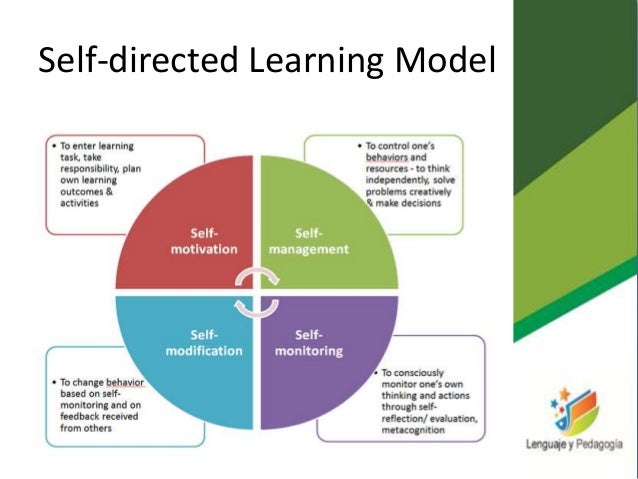
This week I was able to study the idea of the "self-directed learner". This person strives to not only expand their knowledge through "alternate learning pathways" but also find new and creative ways of communicating their skills to others.
In a world of credentials and degrees this type of learning can be challenging and deciding to take a more conventional route towards learning new skills is sometimes the wise choice. However, it takes a clear understanding of oneself and one's own objectives in order to come to such conclusions.
For any self-directed learner, the following questions should remain at the forefront of the learning process:
- What do you know? What don’t you know?
- How do you achieve goals to learn something new?
- How do you show what you know and can do? How do you tell your story with narratives and              numbers?

(An example of a Self-directed learning model)

Friday, February 5, 2016

Storytelling Week 3: In Dark Corners

King Dasaratha could not believe his eyes. Before he could even utter a word, his knees buckled bringing him to the ground. 

"...Ka-Kai-Kaik-Kaike" stuttered the king as he struggled to utter her name.

Minister Sumanthra entered the kopa gruha in search of Dasaratha.

"My king, please tell me what has brought you to your knees?" muttered Sumanthra as he cautiously made his way past the curtain.

"We do not have much ti-…. oh no!!" Sumanthra stood in shock as he gazed upon the body of Kaikeyi, soaking in a pool of blood.

Royal guards questioned everyone from the jester to Sumanthra himself. Not a soul could rest that night as the castle fell into chaos. Outraged by the news, Rama and his brothers stormed into the king's chambers expecting to receive orders from their father. Deeply saddened, but determined, the king rushed out of his chambers as quickly as the princes entered.

"There is no time to waste! We must question the last person to witness Kaikeyi alive," said the king.

"Our maids say that they saw a hunchback limping out of the queen's room mere hours before we discovered the body."

And so the king hurried to the cell where soldiers had captured and interrogated Kooni, the hunchbacked servant. As they moved through the castle, the shadows of distraught men, a backdrop to candle light, scurried across the walls of the dark hallway. All throughout the halls men howled and wildly accused the common servants. Rama showed concern for these commoners and resolved any disputes as he saw them. But the chaos was too great.

"Find the killer and this madness will leave us," groaned Dasaratha, looking forward with great resolve.

The guards sliced and bruised Kooni beyond recognition.

"My lord, the hunchback has been devising a trap," said the soldier as he presented the king with notes on Kooni's plot, beaten out of her without mercy.

She was suspended upside down, a rope stretching from the ceiling as her only savior against a container of scorpions resting just inches from her head. As her lips shivered, she forced them open despite the enormous swelling across her face, so severe that she could no longer see two feet ahead of her body.

"I-I-It is surely," blurted Kooni while coughing uncontrollably, "your own evils which have caused this misfortune to f-fa-fall upon you."All eyes in the room were on her.

"I was not the one who cut down Kaikeyi, but surely it was one of my brothers."

Kooni and the other slaves had been planning a revolt. The king had spent years abusing them, forcing them into dangerous lands virtually unprotected to harvest crops.

"We are less than human to you. So we shall treat you like the monsters that you yourself have created!"

Upon hearing these words, a great anger welled up inside Dasaratha as he shoved even his sons aside, making his way to this battered woman. After striking her across the face, he exclaimed,

"You dare murder Kaikeyi for your petty grievances! You creatures were blessed to stumble upon my kingdom. For in any other you would have been pierced through the heart and fed to the dogs. It was the queen herself who took pity on you and now she has paid greatly for her kindness."

And as quickly as it rose up inside him, the king subdued his anger, replacing it instead with an overwhelming sadness. Despite his words he was unwilling to face Rama who was ignorant of the servants' plight, now gazing upon his father with a look of shame and disgust. Later that night, the king stood on the highest balcony of the castle gazing upon the stars for an answer.

"What do I need to do for this kingdom, for my beloved Kaikeyi?" he thought to himself.

Suddenly, Dasaratha heard footsteps, the sound growing louder with each second. He spun around and stared at the door which sealed the only staircase. Dasaratha gripped the hilt of his sword, preparing for a battle without a single ally. He could almost taste the malice in the air as the presence grew closer. As the door swung open, the king released a sigh of relief as none other than Rama stood at the entrance with a faint smile. Surely, the king had reached news levels of paranoia.

"You have done a great many wrongs against these slaves," said Rama. "Just as you mourn, my heart also aches for Mother. But we cannot ignore the plight of these rebels."

Facing the stars once more Dasaratha stood at the edge of the balcony. "I am truly blessed to bear witness to your kindness, Rama. But what do you suppose I do with subjects who have turned traitor?"

"The answer is simple, Father." replied Rama. "In fact there is but one answer that will deliver justice."

"But what could that be, my so-”, as the words left his mouth, the king noticed a sharp, warm sensation in his chest.

 As he looked down, to his dismay he gazed upon the tip of a blade, plunged through his heart. Blood gushed out of his mouth and splashed on the blade. He used his last ounce of energy to spin around and drop himself into the arms of Rama.

"Tell me, my son, what demon has possessed you?" muttered Dasaratha as the blood gurgled in his mouth.

"I simply grow tired of this charade," replied Rama. "The charade of the perfect son, husband, brother and prince. This image of perfection that has been imposed on me is but a farce used to compensate you all for your own dark hearts. No more, Father."

Those were Rama’s final words to Dasaratha, and in his final moments he bore witness to a sight that terrified him. It was Rama’s sinister smile, stretching unnaturally from ear to ear. His eyes stretched open grotesquely, almost popping out of Rama’s head.

(Rama deformed by his madness)

Author's Note

I was inspired to write this story by a previous post that I had made concerning the relationship between Kooni and the queen. While studying their conversations for the first time I could not help but think that if this story was anything like the mystery novels that I have read that there would be an ulterior motive to Kooni's influence in this scene. In imagining what that motive could be I thought of a rebellion. But the challenge of revealing a surprising yet convincing murderer was still unresolved. After much thinking I figured that Rama would be seen as the most innocent character in this story because of the impressions created of him in the original story by the other readers in the class. I also concluded that realistically any person could feel crushed by the expectations placed on Rama. They may even feel robbed of a satisfying life because of these expectations.
The story is also meant to confront the idea of perfection. Throughout the original narrative, the reader notices that even Rama can sometimes fall victim to his desires and make hasty decisions. But somehow Rama is able to justify his own actions. Even the murder of Vali at Rama’s hands is justified in some manner. Therefore, the following question prevails,

“Is perfection the ability to know all answers coupled with the timely execution of deeds, or is perfection simply the ability to convince others of the righteousness of one’s actions?”

Original Text
"The Ramayana" by R. K. Narayan

Bibliography
Manthara and Kaikeyi (PDE story is slightly different from Narayan's physical text)

Kaikeyi and Dasaratha (Spellings may differ between PDE and physical text which was used for the story)

Week 3 Reading Diary: Ascension to the Throne:


Thursday, February 4, 2016

Week 3 Reading Diary: Ascension to the Throne

Before Rama can perform the ceremony to officially become king of Ayodhya, he is exiled through the fulfillment of a promise made to Kaikeyi by the king Dasaratha. While this sinister plot depicts a challenging chronicle in the life of Rama and his loved ones, the exchange between Kooni and Kaikeyi introduces some interesting elements to the story.
Kooni is the hunchback who convinces the queen that Rama's rise to power puts her position in great peril. However, this exchange is depicted in a comedic fashion as we see Kooni frustrated at the innocence of the queen in supporting the king's decision to place Rama at the throne. As the hunchback's predictions are eagerly rebuffed by the queen, the author describes Kooni's  bodily expressions in quite an exaggerated manner. Kooni's impatience with Kaikeyi is comedic as her body language combined with the queen's response to her actions presents the hunchback as the wiser of the two characters.
(Kaikeyi, in the kopa gruha.)
Supposedly, only the servant can see a plot unfolding to which the queen is oblivious and laments at the treachery being performed against a queen as innocent as "a little dove flitting at the jaws of a wildcat". Kooni's condescension only adds to the humor in this scene.
The reader may observe that Kaikeyi in particular is presented as having a significant number of hunchbacks and deformed humans in her service. And so the author depicts an interested dynamic between the servant and Kaikeyi that may represent a symbolic meaning for the queen's position in Ayodhya.

Wednesday, February 3, 2016

Week 3 Reading Diary: Narayan's "The Ramayana"

Throughout Narayan's "The Ramayana", the passage of time is stretched tens of thousands of years, giving the reader a false impression of immediacy in the story. Perhaps this is meant to highlight the longevity of the both the characters and their motivations, delivering a strong sense of tradition in the process.
The intentions of major characters in Viswamithra's stories to Rama often reflect a morals or values that are timeless. Bhagiratha, for the sake of bringing salvation to his ancestors, prayed to the gods and fasted for thirty thousand years so that the Ganges river could be brought to earth. Honoring one's family through discipline and responsibility seems to be a key theme in this story, reflecting values that are meant to persist through the generations.


(Bhagiratha witnessing Shiva receive the impact of the Ganges.)

When the god Indra covets Brahma's creation Ahalya so intensely that he transforms into her husband to deceive her, the sage Gautama delivers a severe and lasting punishment. Retribution, even for gods can be observed in these Indian epics but this story is peculiar in that a god is soundly beaten by a human. The gods are described as having divine obligations that extend beyond the capabilities of man. And yet, we see that the gods are sometimes at the mercy of humans and even portrayed as their ethically inferior counterparts.

In this sense the gods may be seen as personifications for the thoughts and feelings that drive humans, often feelings that must be subdued in order to overcome one’s own weaknesses. This idea allows for a reading of the text that gives the impression that Rama himself is meant to learn and mature from hearing these stories while also being doomed to fall victim to his own cautionary tale.

Monday, February 1, 2016

Week 2 Reading Diary: Narayan's "The Ramayana"

In reading this text, one of the most striking plot devices was the punishment of women during Viswamitha's stories to Rama and Lakshmana and during their encounter with Thataka. I believe that in describing how Thataka is tainted with power and "loses all consideration to be treated as a woman" the narrative foreshadows the way that Rama treats his wife near the end of the narrative. It is even presented as a divine right when Vishnu is described as slaying women who stood against is righteous crusade against the asura. It is almost as though Viswamithra's teachings and the past lives of Vishnu himself are all meant to make the demise of his relationship with Sita inevitable.
This part of the story is also presented as a major stepping stone for Rama as he loses his innocence at the moment that he kills Thataka. For those who are familiar with the entire story, it is interested to note how this loss of innocence effects Rama's ability to decide when killing is just which is particularly important when he faces the monkey king and Ravana later during his journey.
(Thataka, princess turned demoness)

Another interesting element in Narayan's book is his use of separate narratives within the main story. Through Viswamithra, he uses the past lives of Vishnu to add more depth and mysticism to the already detailed settings portrayed in the story. Rama's destiny as a vanquisher of evil is also further cemented by the stories of good and evil proposed by the guru.

Author: R. K. Narayan


Monday, January 25, 2016

Learning Challenges

The funny thing about using health and happiness as a category is that it sometimes feels as though improving in all other areas is the key to happiness and therefore focusing on happiness means focusing on all areas. And so one can assume that if happiness has an affect on health which I believe it does then happiness becomes a category above the rest. This may be an odd or even misguided perspective but I thought that the idea was worth sharing.
(The three keys to enjoying life)
With respect to the videos, the first video was very powerful. Scattering the beans across the floor and manipulating them in such a manner was very effective in showing how much time we might be wasting each year and also how much time we may have left. The second video was quite entertaining and funny, with a similar idea being expressed in a more humorous and lighthearted manner.
To excel in even one of the categories of the H.E.A.R.T. would cause a profound difference in the way a student spend their time. I am definitely interested in how this can be used to help me excel as a student.


Favorite Places: Philadelphia

Here is a photo of Philadelphia. The last one didn't seem to display properly.
 Philadelphia
(Philadelphia in Pennsylvania)


Growth Mindset

The growth mindset seems particularly useful for overcoming the paralysis that sometimes comes along with facing challenges. Sometimes not knowing right away what the best course of action is creates a fear and desire to avoid the challenge all together. But it seems that with growth mindset one would now be motivated or even compelled to be in such situations on a weekly if not daily basis.
Also, I can appreciate such an approach for its potential for helping people to overcome failure. Our ability to make bold moves in the future is greatly influenced by how we process failure.


(The cha-cha dance)

Personally, some of my greatest learning challenges at college involve figuring out the order of how I accomplish tasks. Deciding which task is most pressing and how much time should be delegated to each is often a great source of anxiety. I look forward to exploring how this mindset can help me understand more about how I should tackle such issues.
I actually have the "Mindset" book by Dr. Dweck. Hopefully the exercises in this class will motivate me to practice the principles from the book as I continue reading.

Friday, January 22, 2016

Storybook Favorites

I have chosen 3 storybooks that reflect my personal interests as well as issues that I believe are still relevant in today's society.

Due to my appreciation of crime dramas and mystery stories I could not avoid the "CSI: Indian Epics" and "The Adventures of Sherlock Holmes: The Mystery of the Missing River" storybooks.

During the introduction the reader is immediately thrust into the world crafted by the writer with a mysterious journal.

(Image Information: Made in Paint. Original Photo Source: Pinterest)

As the title suggests, the CSI themed storybook gives accounts of the deaths of Drona, Karna and Bhishma in a clever way that relates to actual crime scene investigation and autopsy procedures. the method used to convey the information in the form of a report helps to build the tone of a crime drama while at the same time making the information very easy to follow. 

~~~

"The Adventures of Sherlock Holmes: The Mystery of the Missing River" definitely stood out to me due to my following of all recent Sherlock Holmes television and movie titles. The writer shows knowledge of the popular characters in his introduction that is sure to attract fans of the Arthur Conan O'Doyle stories.

The font used in displaying text to the reader helps to a create a very classic and elegant portrayal of the story which reflects the timeless appeal of the Holmes mysteries. The information is very easy to follow and concise. There is also an appropriate use of images which does not distract the reader too much from the story while effective in bringing the eye's focus to the center of the page where is segment of the story begins.

~~~

The final storybook that I chose, "Tales of Strength and Struggles" is very relevant because it touches gender discrimination and double standards for women which are still very persistent issues today. The struggle of the women as well as their journey of growth and acceptance even after death creates a poignant yet triumphant drama. 

I believe that the writer uses the fantasy and wonder of the heavens in a clever way so as to gather all the necessary key figures in the story. This storybook may appeal to the modern reader as it touches on a tender spot for many communities in which women are treated unfairly.


Indian Epics Course Overview

I am planning to read R. K. Narayan's Ramayana. I have already purchased the book and I also believe that I learn better from studying with physical copies rather than electronics copies. The modern style may also help with understanding the text since I have never taken a course on epics since studying  Beowulf in high school.

In my home country Diwali is recognized as a public holiday. Much of what I know about Indian culture stems from the description of this holiday and the stories told around that time of year. There are also channels available that present Indian plays and Bollywood all day.

Growing up as a Catholic, the Bible would be the sacred religious text that I have been most exposed to in my life.I do have some relatives that follow Islam so I have been exposed to the Qur'an on occasion. While I do have some Indian heritage on my mother's side we were not exposed to a lot of Indian culture and we are not in regular contact with our distant relatives from India.

I have chosen to include the image entitled "Krishna Holds Up Mount Govardhan". This image stood out to me because it reminded me of the Titan Atlas in Greek mythology who was tasked with holding up the sky.


(Krishna Holds Up Mount Govardhan
Date: ca. 1590–95; present-day Pakistan, probably Lahore

Thursday, January 21, 2016

Introduction to an Information Security Analyst


Hello everyone, my name is Eaton Baptiste. I'm a senior here at OU. Currently I am studying Management Information Systems with the intention of becoming a security analyst, but I'm still not sure what company would be the best fit for me.


When I am not learning about new programming languages and networks I enjoy sketching. I sometimes draw pictures for people as gifts not because I think that I am a great artist but because I think that putting thought and energy into something is the best way to make a gift meaningful and that is what I try to do with my pictures. I prefer to sketch animals.

Also, I enjoy running. My distance right now is not too long but I entered a 5k race last semester which was progress for me even though I only placed in the first couple hundred out of 800 people. Sometimes its best to get a group of people together for running because it helps to keep the motivation going (especially when its freezing outside).

Even though I am not American I have a few relatives here in the U.S.. During the summer I might visit Boston to see my great grandmother and aunts or New York to visit my uncle. When I was a kid it was pretty typical for our family to visit amusement parks like Six Flags New Jersey or New Hampshire during the summer.

Just a few random things about me:
 - I am a strong proponent of the three day weekend and hope to pioneer this in my home country some day.
 - Mystery novels are some of my favorite reading books.
 - I watch a lot of movies.
 - I hope that Leonardo Dicaprio finally wins an Oscar for "The Revenant".

I look forward to the new year and I hope that you all have a good one too.

10 Cyber Security Facts - WMNews Ep. 4


Who else watches Jimmy Kimmel Live!?


Week 1 Storytelling: A Farmer's Tale

HERCULES AND THE WAGONER

A Farmer was driving his wagon along a miry country road after a heavy rain. The horses could hardly drag the load through the deep mud, and at last came to a standstill when one of the wheels sank to the hub in a rut.
The farmer climbed down from his seat and stood beside the wagon looking at it but without making the least effort to get it out of the rut. All he did was to curse his bad luck and call loudly on Hercules to come to his aid. Then, it is said, Hercules really did appear, saying:
"Put your shoulder to the wheel, man, and urge on your horses. Do you think you can move the wagon by simply looking at it and whining about it? Hercules will not help unless you make some effort to help yourself."
And when the farmer put his shoulder to the wheel and urged on the horses, the wagon moved very readily, and soon the Farmer was riding along in great content and with a good lesson learned.
Self help is the best help.
Heaven helps those who help themselves.
~~~
Looking at his broken down wagon, the farmer lamented his poor fortune and pleaded with the Gods to help him. 
"Oh great ones up high," said the farmer, "I have worked to long and hard to get this wagon over the hill, please do not let all my work go to waste"
However, instead of a god the great Hercules appeared before him, suspiciously pale with a cane in hand. Refusing to help unless the man himself made a greater effort, the farmer was tasked with moving the wheels himself. The farmer pleaded once more:
"But surely with your incredible strength I need not struggle with this wagon myself. Did you not arrive to rescue me from this stroke of bad luck"
The farmer was met with a piercing gaze and the warrior Hercules refused once more, urging the farmer to put his own strength to the test.
"Put your shoulder to the wheel, man, and urge on your horses. Do you think you can move the wagon by simply looking at it and whining about it? Hercules will not help unless you make some effort to help yourself."
Reluctantly the farmer placed his skinny, feeble hands on the wagon and with a deep breath began to push while urging the horses to move. It was at this moment that something unbelievable occurred
The wagon which, moments ago, felt rooted to the ground refusing to budge even an inch, was now being casually pushed up the hill as though being carried by twenty horses. But it was none other than the modest farmer, shocked at his own strength as he began forcing the wagon across the path with a single hand. 
Growing in strength with each step, by the time the farmer got over the hill, he grabbed the wagon once more with his right hand and lifted the entire object several feet off the ground with a deceptive display of ease. He gazed at Hercules as though expecting an answer to this miracle.
"What magic is this great warrior," said the man "that a mere farmer such as I may lift this wagon off the ground and feel only the weight of a feather?"
Hercules explained to him that his being there was not simply to help the man but also to help himself:
"I am slowly dying from a curse for which even the Gods themselves have no remedy. My father Zeus took pity on me and agreed to bestow my powers upon one that I deem worthy. I must confess that I have been watching you for some time now. I have borne witness to your many acts of kindness and so I have come to see you accept this power in person."
And so the farmer named Anicetus accepted this gift and set forth throughout the land doing good in the name of Hercules.
AUTHOR'S NOTE
The fable used here is meant to teach the lesson that there is great value in helping oneself before trying to request help from others. In the fable the farmer is able to use his own strength to push the wagon. But this only occurs because Hercules helps him to realize his own strength. Therefore, I decided to take a much more literal approach to the idea of the farmer discovering strength through Hercules. Also, the farmer is named after one of the sons that is born after Hercules dies and becomes a god. I thought that using this the name Anicetus would add greater meaning to the idea that the farmer carries on Hercules' legacy just as a son may do for his father.
BIBLIOGRAPHY
The story is based on the fable "Hercules and the Wagoner" in Aesop for Children, by (anonymous), illustrated by Milo Winter (1919)

Wednesday, January 20, 2016

Parlatuvier Bay, Philadelphia, Monteverde..... Favorite Places

I grew up in Trinidad and Tobago, a Caribbean nation off the coast of Venezuela. Going to the beach was a great way to spend the holidays.
(Parlatuvier Bay in Tobago:


I have many relatives in the U.S.. I have spent a lot of time in some of the states near the east coast, particularly Pennsylvania.
(Philadelphia in Pennsylvania:


When I was 16 years old, I traveled to Costa Rica for a two-year study abroad program. During our yearly "Project Week" we visited a rain forest called Monteverde in order to build drainage systems and walkways for tourists.
(Monteverde in Costa Rica: