In studying the conflict between the Pandavas and the Kauravas, the king Dhritarashtra may be identified as a major source of turmoil for the Pandavas.
Even though he is caring and considerate of his nephews, he cannot overcome his bond with the "jackal" ,Duryodhana, who coerces him into making reprehensible decisions. This prince displays such a ferocious contempt for the Pandavas that he continuously plots for their humiliation and demise. His plans are executed in the midst of the king without reproach due to Dhritarashtra's inability to take a firm stance with his own son. Duryodhana's actions seem to propel his kingdom further into a state of depravity.
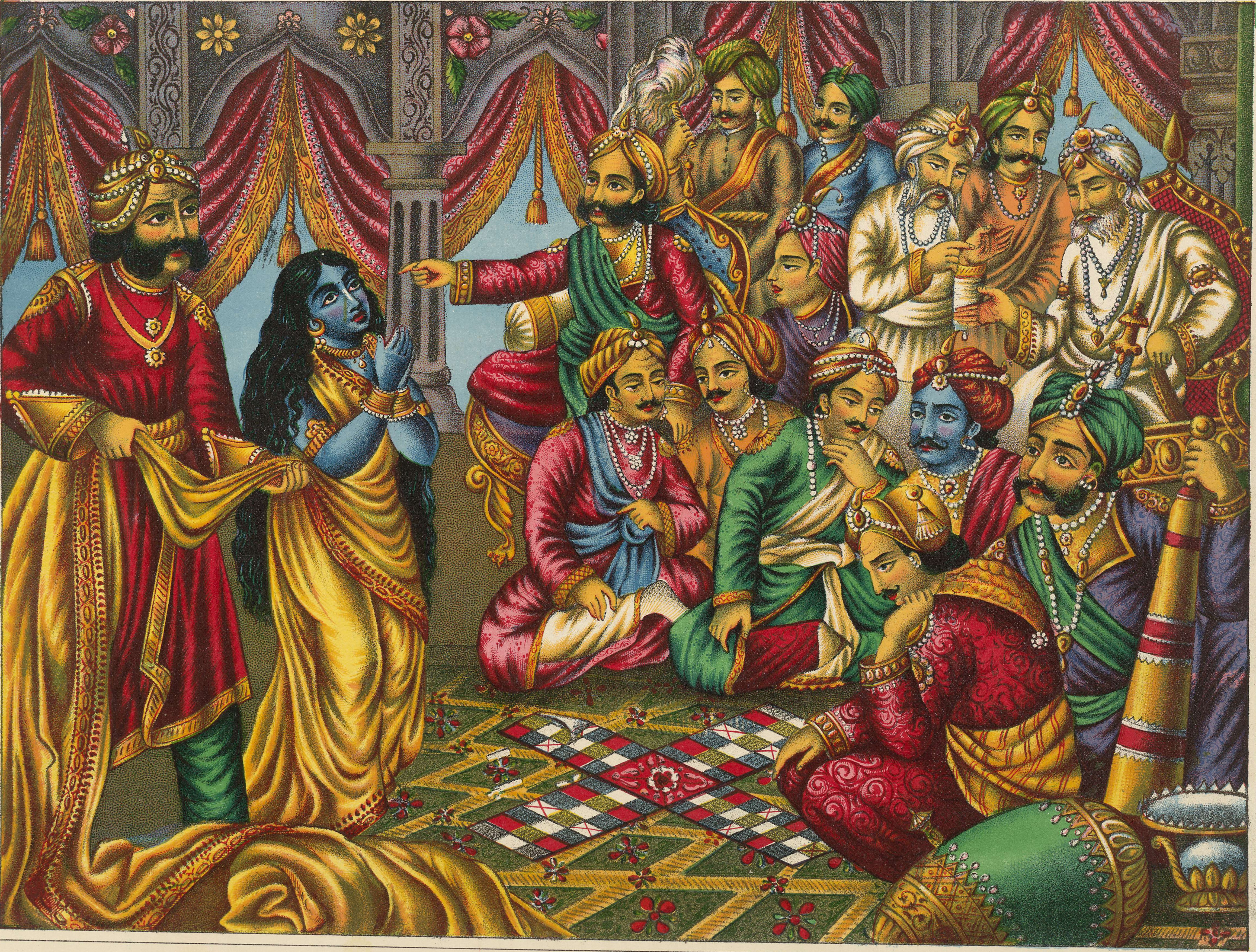
Arguably, some of the plots set by Duryodhana would not have been successful if not for the foolishness of the Pandavas. The reader may observe the gambling debts that are incurred by the king
Yudhishthira not once but twice. Some may argue that Yudhishthira does not incur these losses out of foolish pride but due to his promise never to make decisions that divide people. This coupled with his sense of obedience to his uncle may be seen as a more likely reason for the events that unfold surrounding his decision to gamble.
Showing posts with label Reading Diary. Show all posts
Showing posts with label Reading Diary. Show all posts
Thursday, February 25, 2016

Monday, February 22, 2016
Week 5 Reading Diary : Feuding
The main themes within the Mahabharata include family feuds and corruption. When the Pandavas are encouraged to leave the city for a relaxing family vacation of sorts, the trip turns out to be a plot by the Kaurava to murder their own family members so that there will be no contest for the throne. With the Pandavas dead the notoriety will remain with the Kaurava princes. We see here how the lust for power coupled with envy of others is able to twist one's mind.

Although the Pandavas in all their greatness are often described as being unfair in their treatment of their cousins. The relationship dynamic between the Pandavas and the Kauravas does well to examine the question of morality and what makes up a characteristics of a righteous person. Is it enough to be born into royalty like the Kauratas and Pandavas? Or must one inherit otherworldly skill and prominence? All these seem to indicate some level of greatness and yet none are directly linked to righteousness.
(The Pandavas escaping the burning house.)

Although the Pandavas in all their greatness are often described as being unfair in their treatment of their cousins. The relationship dynamic between the Pandavas and the Kauravas does well to examine the question of morality and what makes up a characteristics of a righteous person. Is it enough to be born into royalty like the Kauratas and Pandavas? Or must one inherit otherworldly skill and prominence? All these seem to indicate some level of greatness and yet none are directly linked to righteousness.
Thursday, February 18, 2016
Week 5 Reading Diary: The Mahabharata
What may be quite striking to the reader is the elaborate
nature in which the Pandavas are born to queens Kunti and Madri. Through the
incantation of mantras that call out to the gods, king Pandu's wives give birth
to these five brothers. Comparing these characters to Rama, we see the
significance of such godlike figures in both epics as symbols of perfection,
hope and even envy for the people surrounding them.

(The Pandavas, made up of the five brothers previously mentioned.)
The idea of half human children reminds me of many tales in
Greek mythology. Countless demi-gods are born through the dalliances of gods
such as Zeus who, while on earth, typically engage any woman they chose,
sometimes even while in the form of other creatures. In a similar fashion to
the Mahabharata, many of these half-humans grow to become legendary warriors, a
well-known example being Hercules.
Incarnation is still an expected occurrence in this epic,
however much attention is given to royal lineage and class systems. The
Pandavas are born partly out of a need to establish potential heirs to carry on
the succession of the throne. With this, the focus of this narrative seems to
be more about the feud between individuals of royal bloodlines rather than the
destiny of certain characters to deliver justice to the world, as is the case
with Rama's true calling.
Thursday, February 11, 2016
Week 4 Reading Diary : Narayan's Ramayana
At the conclusion of Narayan's Ramayana, the reader finds that there is a certain peace and reconciliation that is granted to many of the tormented characters in this narrative.
Ravana's demise is met with a subtle mood of sadness for how far he had fallen from grace. However, Rama still speaks for his rightful place in heaven while conferring proper funeral rights to his brother Vibishana. The mercy shown by Rama may contrast with the earlier, more controversial chapter in which he kills Vali with an arrow through the chest. Even though Rama justifies his actions to a creature that has already committed wrong, his reasoning is described in a manner that may be purposefully meant to elude the understanding of the reader so as to present Rama's reasoning as beyond that of conventional human understanding.

This method may be observed once more in Rama's decision to subject Sita to the trial by fire for which he claims is meant to remove all doubt from the world as to her purity. However, Rama's human nature seems, at times, to be at odds with his more godly attributes as stated in the text.It is at this instance that Rama, together with his father are able to find peace in each other's words. Dasaratha's forgiveness of Kaikeyi and her son, together with Rama's accomplishments, delivers to him an inner peace which had eluded him even in heaven. Rama, on the other hand is filled with joy over his father's words of praise and is content to find that Dasaratha delivers on Rama's wish that he accept Kaikeyi once again as family.
The fate of these three characters - Ravana, Sita and Rama are reconciled in such a way that may be akin to the trinity of Hindu faith. Even Brahman himself comments on Sita and Rama's place in the trinity while Ravana is once blessed with power by the great destroyer Shiva. Perhaps the writer views the reconciliation of these characters as inevitable in order to truly "conclude" his story.
Ravana's demise is met with a subtle mood of sadness for how far he had fallen from grace. However, Rama still speaks for his rightful place in heaven while conferring proper funeral rights to his brother Vibishana. The mercy shown by Rama may contrast with the earlier, more controversial chapter in which he kills Vali with an arrow through the chest. Even though Rama justifies his actions to a creature that has already committed wrong, his reasoning is described in a manner that may be purposefully meant to elude the understanding of the reader so as to present Rama's reasoning as beyond that of conventional human understanding.
(Sita emerges victorious during her trial by fire.)
The fate of these three characters - Ravana, Sita and Rama are reconciled in such a way that may be akin to the trinity of Hindu faith. Even Brahman himself comments on Sita and Rama's place in the trinity while Ravana is once blessed with power by the great destroyer Shiva. Perhaps the writer views the reconciliation of these characters as inevitable in order to truly "conclude" his story.
Thursday, February 4, 2016
Week 3 Reading Diary: Ascension to the Throne
Before Rama can perform the ceremony to officially become king of Ayodhya, he is exiled through the fulfillment of a promise made to Kaikeyi by the king Dasaratha. While this sinister plot depicts a challenging chronicle in the life of Rama and his loved ones, the exchange between Kooni and Kaikeyi introduces some interesting elements to the story.
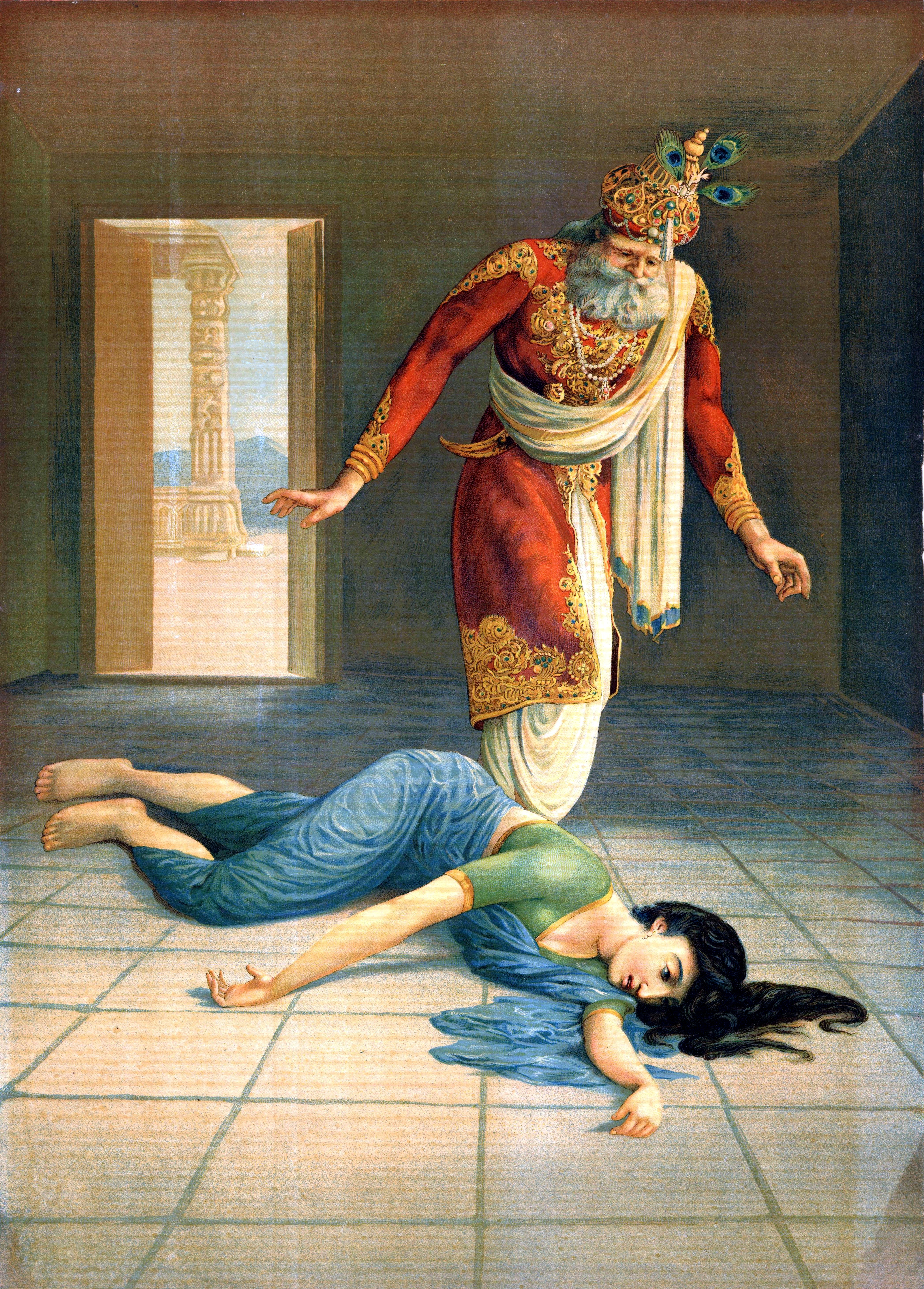
Kooni is the hunchback who convinces the queen that Rama's rise to power puts her position in great peril. However, this exchange is depicted in a comedic fashion as we see Kooni frustrated at the innocence of the queen in supporting the king's decision to place Rama at the throne. As the hunchback's predictions are eagerly rebuffed by the queen, the author describes Kooni's bodily expressions in quite an exaggerated manner. Kooni's impatience with Kaikeyi is comedic as her body language combined with the queen's response to her actions presents the hunchback as the wiser of the two characters.
(Kaikeyi, in the kopa gruha.)
Supposedly, only the servant can see a plot unfolding to which the queen is oblivious and laments at the treachery being performed against a queen as innocent as "a little dove flitting at the jaws of a wildcat". Kooni's condescension only adds to the humor in this scene.
The reader may observe that Kaikeyi in particular is presented as having a significant number of hunchbacks and deformed humans in her service. And so the author depicts an interested dynamic between the servant and Kaikeyi that may represent a symbolic meaning for the queen's position in Ayodhya.
Wednesday, February 3, 2016
Week 3 Reading Diary: Narayan's "The Ramayana"
Throughout Narayan's "The Ramayana", the passage of time is stretched tens of thousands of years, giving the reader a false impression of immediacy in the story. Perhaps this is meant to highlight the longevity of the both the characters and their motivations, delivering a strong sense of tradition in the process.
The intentions of major characters in Viswamithra's stories to Rama often reflect a morals or values that are timeless. Bhagiratha, for the sake of bringing salvation to his ancestors, prayed to the gods and fasted for thirty thousand years so that the Ganges river could be brought to earth. Honoring one's family through discipline and responsibility seems to be a key theme in this story, reflecting values that are meant to persist through the generations.

The intentions of major characters in Viswamithra's stories to Rama often reflect a morals or values that are timeless. Bhagiratha, for the sake of bringing salvation to his ancestors, prayed to the gods and fasted for thirty thousand years so that the Ganges river could be brought to earth. Honoring one's family through discipline and responsibility seems to be a key theme in this story, reflecting values that are meant to persist through the generations.
(Bhagiratha witnessing Shiva receive the impact of the Ganges.)
When the god Indra covets Brahma's creation Ahalya so
intensely that he transforms into her husband to deceive her, the sage Gautama
delivers a severe and lasting punishment. Retribution, even for gods can be
observed in these Indian epics but this story is peculiar in that a god is soundly
beaten by a human. The gods are described as having divine obligations that
extend beyond the capabilities of man. And yet, we see that the gods are
sometimes at the mercy of humans and even portrayed as their ethically inferior
counterparts.
In this sense the gods may be seen as personifications for
the thoughts and feelings that drive humans, often feelings that must be
subdued in order to overcome one’s own weaknesses. This idea allows for a
reading of the text that gives the impression that Rama himself is meant to
learn and mature from hearing these stories while also being doomed to fall
victim to his own cautionary tale.
Monday, February 1, 2016
Week 2 Reading Diary: Narayan's "The Ramayana"
In reading this text, one of the most striking plot devices was the punishment of women during Viswamitha's stories to Rama and Lakshmana and during their encounter with Thataka. I believe that in describing how Thataka is tainted with power and "loses all consideration to be treated as a woman" the narrative foreshadows the way that Rama treats his wife near the end of the narrative. It is even presented as a divine right when Vishnu is described as slaying women who stood against is righteous crusade against the asura. It is almost as though Viswamithra's teachings and the past lives of Vishnu himself are all meant to make the demise of his relationship with Sita inevitable.
This part of the story is also presented as a major stepping stone for Rama as he loses his innocence at the moment that he kills Thataka. For those who are familiar with the entire story, it is interested to note how this loss of innocence effects Rama's ability to decide when killing is just which is particularly important when he faces the monkey king and Ravana later during his journey.
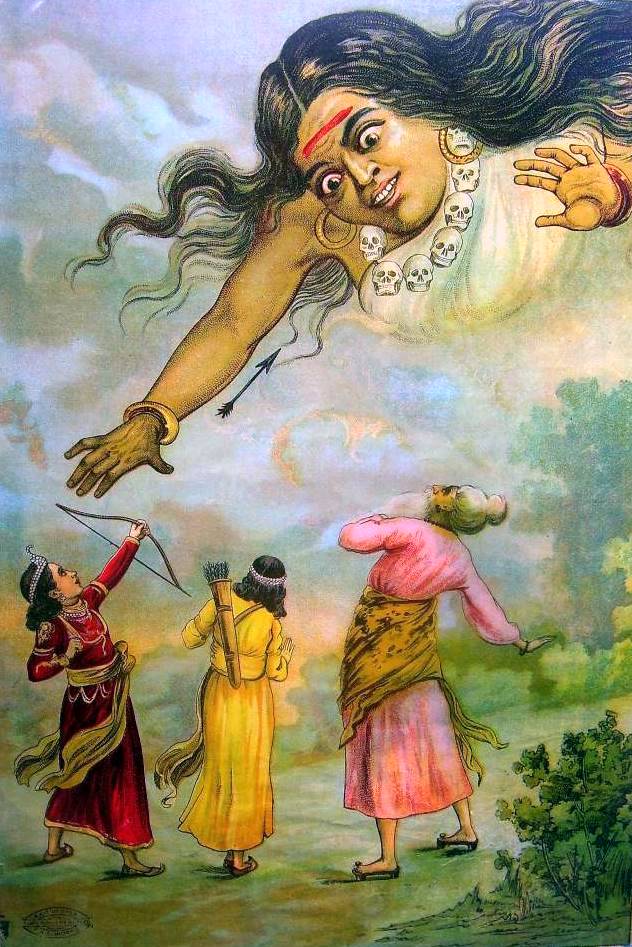
This part of the story is also presented as a major stepping stone for Rama as he loses his innocence at the moment that he kills Thataka. For those who are familiar with the entire story, it is interested to note how this loss of innocence effects Rama's ability to decide when killing is just which is particularly important when he faces the monkey king and Ravana later during his journey.
(Thataka, princess turned demoness)
Another interesting element in Narayan's book is his use of separate narratives within the main story. Through Viswamithra, he uses the past lives of Vishnu to add more depth and mysticism to the already detailed settings portrayed in the story. Rama's destiny as a vanquisher of evil is also further cemented by the stories of good and evil proposed by the guru.
Author: R. K. Narayan
Subscribe to:
Posts (Atom)