This part of the story is also presented as a major stepping stone for Rama as he loses his innocence at the moment that he kills Thataka. For those who are familiar with the entire story, it is interested to note how this loss of innocence effects Rama's ability to decide when killing is just which is particularly important when he faces the monkey king and Ravana later during his journey.
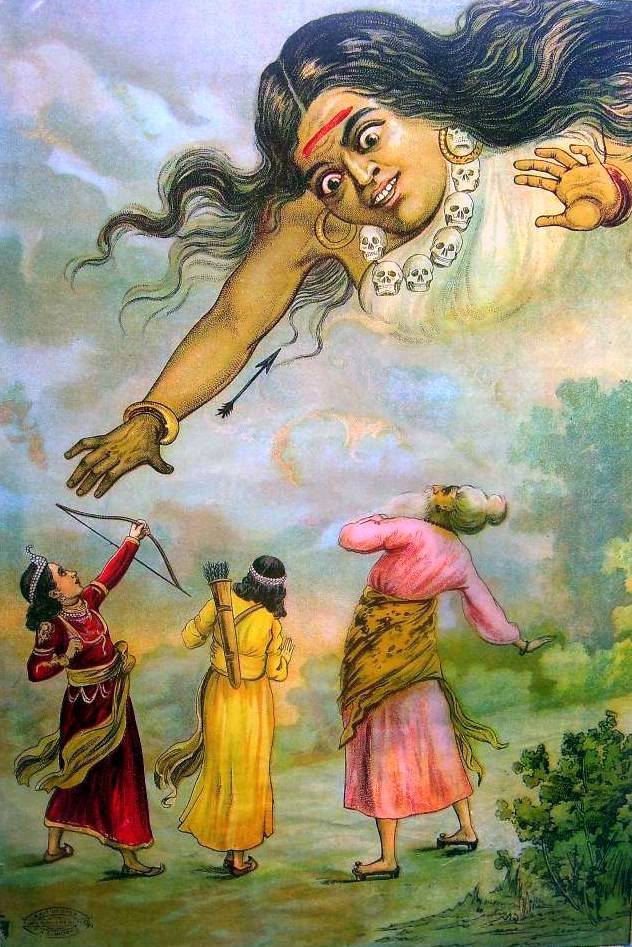
(Thataka, princess turned demoness)
Another interesting element in Narayan's book is his use of separate narratives within the main story. Through Viswamithra, he uses the past lives of Vishnu to add more depth and mysticism to the already detailed settings portrayed in the story. Rama's destiny as a vanquisher of evil is also further cemented by the stories of good and evil proposed by the guru.
Author: R. K. Narayan

Thanks for getting started, Eaton! And you have picked up on an incredibly important theme in this epic, and it will recur in the Mahabharata also: the treatment of women. In some versions of the Ramayana, there is a story of an incident in which Vishnu, in anger, killed the wife of a brahmin. Not just a woman, but a brahmin woman! That is very bad karma. Even gods experience the effects of karma, so the consequence of Vishnu causing that brahmin to lose his wife is that in a later life, as Rama, he loses his own wife. Karma: consequences!
ReplyDelete