Showing posts with label Week 5. Show all posts

Monday, February 22, 2016

Week 5 Reading Diary : Feuding

The main themes within the Mahabharata include family feuds and corruption. When the Pandavas are encouraged to leave the city for a relaxing family vacation of sorts, the trip turns out to be a plot by the Kaurava to murder their own family members so that there will be no contest for the throne. With the Pandavas dead the notoriety will remain with the Kaurava princes. We see here how the lust for power coupled with envy of others is able to twist one's mind.

(The Pandavas escaping the burning house.)

Although the Pandavas in all their greatness are often described as being unfair in their treatment of their cousins. The relationship dynamic between the Pandavas and the Kauravas does well to examine the question of morality and what makes up a characteristics of a righteous person. Is it enough to be born into royalty like the Kauratas and Pandavas? Or must one inherit otherworldly skill and prominence? All these seem to indicate some level of greatness and yet none are directly linked to righteousness.

Week 5 Review

One weekly announcement that caught my attention is the Growth Mindset post about embracing challenges. I am familiar with Dr. Dweck's work with children in fostering healthy learning experiences. However, this post resonates with me during this week in particular. I have been placed in positions of responsibility and leadership throughout the semester. From team projects to my management position at work, I have openly accepted such roles And even though the challenges sometimes seem overwhelming I try to remind myself that what I am trying to accomplish now is more worthwhile than simply avoiding the trouble and doing enough just to get by with school or work.
(Carol Dweck's growth mindset at work!)

Week 5: Famous Last Words

This week I did not do a storytelling assignment. Oddly, it was a bit more difficult for me to focus my thoughts and start writing in the same way that I did in the past. I am hoping that it was due to a time constraint. I do not want to believe that I have just run out of ideas for satisfying stories with so much left to do in the course.
Instead I spent a significant amount of time editing the first story that I wrote following Week 2, "In Dark Corners." I enjoyed writing this story. Even though it may not be perfect I am proud of this work. Typically, I do not see myself as a talented writer much less a storyteller. I watch a lot of movies and read a couple books a year. But that hardly qualifies someone as being a good storyteller. Writing these stories and receiving positive feedback from my peers reminds me of when I first started sketching. I had never had much of a talent for art as a kid. But somehow I just felt motivated to see what my work would look like if I decided to pick up a pencil. And surprisingly I was satisfied with the end result(not always but I made progress).
(How do you see the glass?)

Sometimes I think that I can't keep up with this course. But not because it is unreasonable in its deadlines but because of my weekly schedule and study habits. Even so I enjoy the class and try to stay optimistic. In spite of the work that I missed during Week 2 when I got sick I have been able to catch up by completing the extra credit assignments. I wish that all of my classes would have extra credit assignments that I could do when the regular work got too hectic or I missed a deadline.

Tech Tip: Reverse Image Search

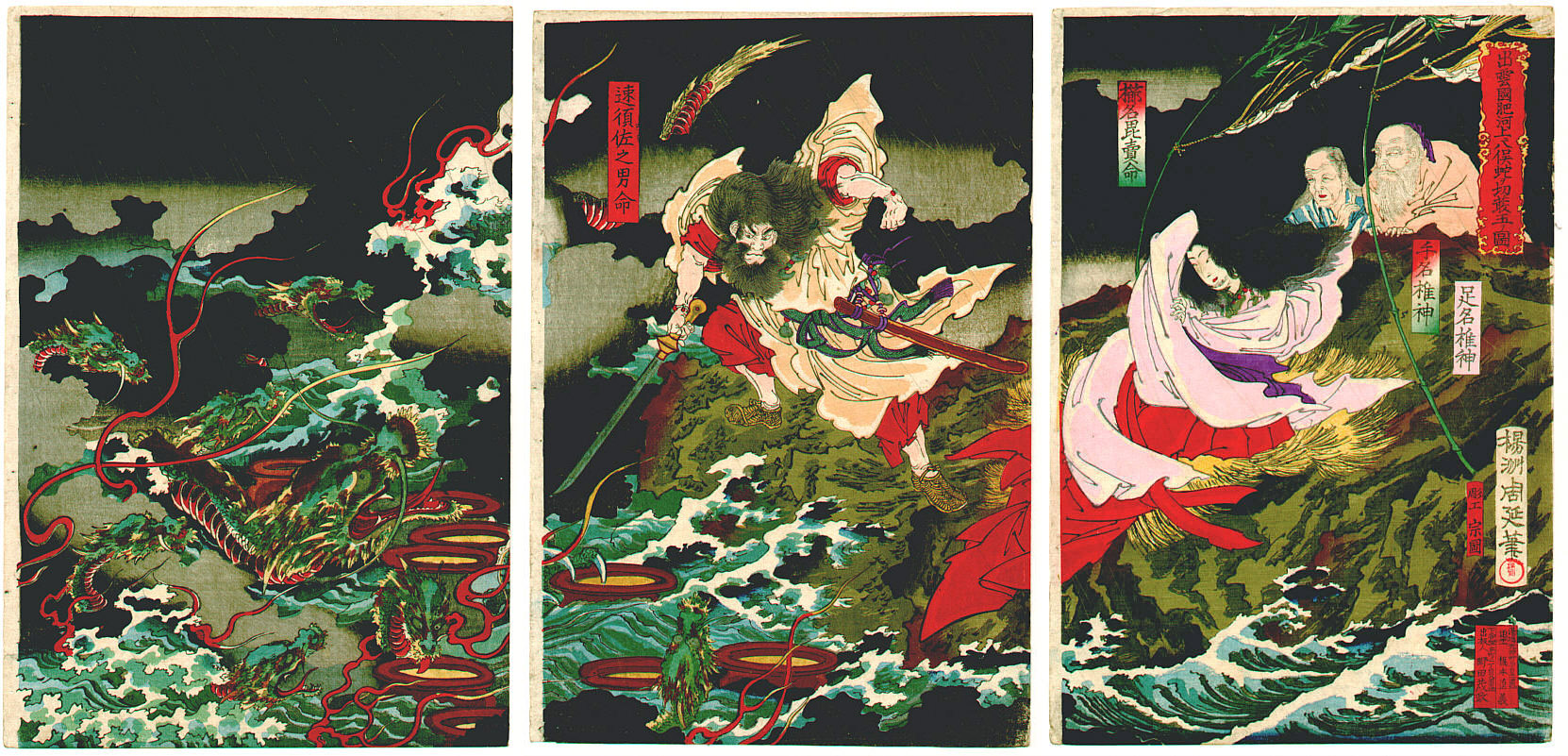
For my reverse image search I used the picture of Susanoo slaying the Yamata no Orochi, by Toyohara Chikanobu. This artwork represents a part of Shinto religion in Japan. The storm-god Susanoo is seen defeating the Japanese dragon Orochi.
(Susanoo slaying the Yamata no Orochi, by Toyohara Chikanobu)

Thoughts about Comments

I have been mostly satisfied with the comments posted about how I can improve my writing. However, at times some comments seem a bit vague. For example a fellow blogger might identify a period during my story in which they were confused about the plot or dialogue (which I admit often needs work). But I think that offering their perspective on how they would structure certain lines that they find peculiar would be most helpful. That way I am not only identifying a problem with my writing but also implementing a solution almost immediately after the comment is read.
I am certainly not asking anyone to rewrite my entire story for me, but I think this method would help each of us to avoid repeating our errors in later stories.

(Fountain pen)

At the same time, I admit to posting a few vague comments of my own. I will also work on providing more sound and constructive criticism to help others improve as well.

Thursday, February 18, 2016

Week 5 Reading Diary: The Mahabharata

What may be quite striking to the reader is the elaborate nature in which the Pandavas are born to queens Kunti and Madri. Through the incantation of mantras that call out to the gods, king Pandu's wives give birth to these five brothers. Comparing these characters to Rama, we see the significance of such godlike figures in both epics as symbols of perfection, hope and even envy for the people surrounding them.

(The Pandavas, made up of the five brothers previously mentioned.)

The idea of half human children reminds me of many tales in Greek mythology. Countless demi-gods are born through the dalliances of gods such as Zeus who, while on earth, typically engage any woman they chose, sometimes even while in the form of other creatures. In a similar fashion to the Mahabharata, many of these half-humans grow to become legendary warriors, a well-known example being Hercules.
Incarnation is still an expected occurrence in this epic, however much attention is given to royal lineage and class systems. The Pandavas are born partly out of a need to establish potential heirs to carry on the succession of the throne. With this, the focus of this narrative seems to be more about the feud between individuals of royal bloodlines rather than the destiny of certain characters to deliver justice to the world, as is the case with Rama's true calling.