Showing posts with label Week 4. Show all posts

Monday, February 15, 2016

Week 4 Review

Reading through the announcements, I noticed one in particular which illuminated the meaning behind the word "Friday". This word finds its origins in Norse mythology from the Goddess of married love, Frigg. This person also happened to be married to Odin. This is particularly interesting when one considers that the word "Thursday" also finds its origins in Norse mythology. I enjoy learning about how a cultures and mythologies that may be considered to be more obscure or less popular were able to influence the world on such a grand scale. Such influences are not limited to the days of the week as everything from our number system, to our units of measurement can be traced back to culturally groups that may seem so different from us.
(The goddess Frigg)

Week 4: Famous Last Words

During this week I was able to finish Narayan's Ramayana. I enjoyed the book thoroughly because of the mythology that was constantly being highlighted throughout the story. Rama is constantly developing relationships with mythical creatures and gods who are often engaged in very "human" tragedies such as familial betrayal and broken hearts. Fantasy stories such as these provide great flexibility for storytelling because the writer can decide how much of the fantasy world and how much realistic drama he/she wants to include in the story.
I am very satisfied with my latest storytelling post. It is an origin story for the king Dasaratha, set in a time when we was just a child. Like I mentioned before, creating a children's tale about surviving a monster's cruelty is just one example of the many interpretations that can be made from the original narrative.
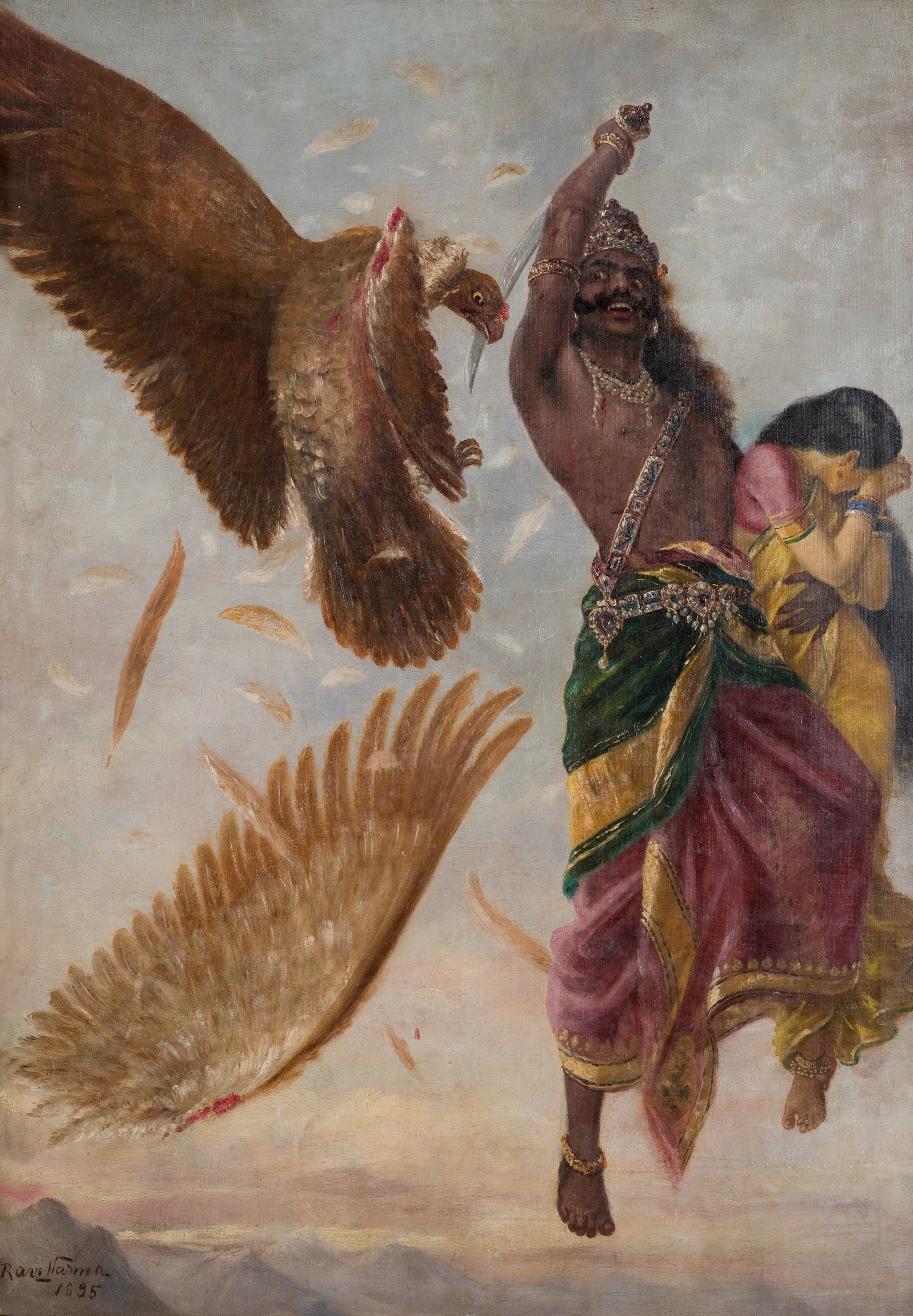
(Jatayu, one of the main characters in my storytelling post, battling Ravana)

One other major milestone for me was my decision to go with the Portfolio project. After considering why exactly I enjoyed writing stories for the readings, it became apparent that the portfolio would give me the creative freedom to produce stories that are less focus on connected plots and more focused on originality.
I have already posted my first story to the portfolio after editing the author’s note. Getting feedback on my stories is something that I look forward to for my storytelling posts so I think that this assignment will fit nicely with my strategy for writing these stories.
Missing so much work in Week 2 was definitely an unfortunate event for me but I am optimistic for the remainder of the semester especially since I am more confident about what my project should be for the remainder of the academic year. After looking at other people’s storybooks and portfolios in the making, the whole process seems a lot more exciting when I think about everything improving and breathing life into their own characters and narratives.

Week 4 Tech Tip: Google Timer

Writing about the Google Timer feature seemed very relevant to me because it was already something that I was doing while using a different timer. As students we can sometimes overestimate the amount of time that we have been doing an assignment, especially if we think that the work is boring. At some point we may convince ourselves that we are already mentally fatigued by the assignment even though only 30 minutes or so have passed.
Timers can help us maintain perspective on how much time should be allocated to studying. If a student spends only 30 minutes of studying for every 3 hours of class that he/she attends then this should be recognized as an area for improvement. If you are just starting out with a timer you can begin with smaller intervals and work your way up to longer periods of study.
Of course this tool can extend to other facets of time management aside from studying. Maybe reading or a hobby can be timed in order to optimize productivity during the day.
(Finding the best balance between work and play is a constant challenge.)

Friday, February 12, 2016

Storytelling Week 4: Close Encounters

Every morning the boy would go climbing on the oldest, largest trees he could find in the forest. It was always so early that the only voices he could hear were the singing of birds and the whistling of leaves as a gentle breeze filled the air. Warm, piercing rays of light would come creeping through the branches.

Preview tree
(The forest where the boy plays every day.)

One morning something odd happened. The boy stumbled across a peculiar tree which stood ominously, enclosed by a field of beautiful flowers. Hesitant at first, the boy gathered his resolve and moved to conquer the tree. He clung to the bark, his hands moving first, then feet, following this rhythm as he moved up the tree. But just as the boy had reached his first branch a terrifying sound erupted.

"You, a mere boy dare to interrupt my slumber!?"

The voice was like a screech that invaded the child's ears and caused such a severe headache that the boy lost control of his grip and fell to the ground. As he lay there writhing in pain, a spider-like creature sped down the tree until its red eyes and fangs, like those of a saber-toothed cat, were but inches from the boy’s face. The creature resembled a human if not for its four arms and legs, covered in thorns. This was a Rakshasa.

"I would eat you right now if not for that wretched stench," howled the beast.

The boy had soiled himself. He remained on the ground shivering uncontrollably as the demon's rancid breath puffed against his face. The child tried to open his mouth to speak, but all that escaped was sobbing. So he closed his eyes and curled up into a ball, quivering in fear. The boy heard yet another screech from the demon.

"Surely, you are blessed by the gods," said the beast, "for I am quite tired today."

"But listen carefully," snarled the Rakshasa. "While you were cowering in fear I, the great Ishnana, placed a curse on you. For whichever tree you attempt to climb will open up and devour you whole."

As Ishnana scurried up the tree, the boy dragged himself in shame as far as he could get from the demon.

During the next few days the child fell into a severe depression. While he sat on a riverbank, a great shadow loomed over him. As he turned around, the child gazed upon a huge vulture descending upon him. The bird moved so quickly that the boy could only shield his face from the strong gust of wind. To the child's surprise the vulture began to speak.

"What has you troubled?" asked the vulture. "I have flown over these woods many times and witnessed you running about gleefully. But today you sit in silence."

With tears in his eyes the boy explained the events that had occurred.

"Dear boy, you are in luck for I know of this creature's weakness," responded the bird.

And so they devised a plan to defeat Ishnana. The boy climbed onto the bird's back and they set off to gather materials for their plan.

Several days later the child cautiously approached Ishnana's tree and called out.

"Oh great one, please allow me to repay you for the mercy that you showed me the other day," declared the child.

The boy stood in silence, anxiously awaiting Ishnana's reply. But there was silence. With a sigh of dismay, the child turned around. But as he was making his way to the riverbank, the tree shook violently. Ishana's thorny limbs scraped and stabbed the tree as he hurried to the ground.

"Not once, but twice you have disturbed me," replied Ishnana in anger. "Explain yourself at once!"

"I noticed that you maintain a beautiful garden," said the child. "But I have found one filled with even more exotic plants."

"Nonsense, there is no such garden in this forest!" shouted Ishnana. "Show me the way and I shall decide for myself!"

The demon did indeed have a weakness for flowers. He collected and planted them tirelessly for his garden. They eventually came before a clearing where the light shone beautifully at its center. And at this point lay a glorious plot of flowers, with colors known only to the Gods.

"Incredible! Some of these flowers cannot be found in this world," said Ishnana as he approached the plot. "How did you discover such a thing?"

But before the creature could hear a response, the ground beneath him crumbled. Ishnana was plunging further and further into a deep pit. At this moment the vulture arrived.

"Jatayu, why have you come here!?" asked Ishnana as he struggled to climb out of the hole. "Is this your doing!?"

"Yes it is I, Jatayu, protector of this forest," said the bird."You have harmed one of my protected creatures and so I sentence you to remain at the bottom of this hole, beneath the flowers you so admire.”

Jatayu then rose up and with two flaps of his wings gathered enough dirt to fill the hole. As Ishnana tried to claw his way out, roots shot out of the inner walls of the pit and like rope restrained the demon. The flowers were indeed otherworldly for they fed on the energy of Rakshasas. Ishnana could only remain there helplessly as the flowers sucked away his life. With the hole sealed, the boy turned to Jatayu in praise.

"Thank you for saving me. I do not deserve such a guardian," said the boy.

"Oh, but few are worthier of protection," responded Jatayu."For I did not appear to you by chance. The gods sent me to protect you. You are to be a great leader. You will nurture a champion among gods, the one who will break Shiva's bow."

"I do not understand," replied the child. "But I hope that we can be friends."

With a look of great joy, the vulture replied, "Surely, we will be brothers."


Author's Note

I was motivated to write this story as sort of an origin to Rama's father. I thought that it would be interesting to know a little more about the great king who had raised so many respected sons. I then remembered his relationship with Jatayu and how it was mentioned that the two characters had had a longstanding relationship with each other before the events of the Ramayana. So creating my own take on his origin story seemed like an interesting idea.

While reading the Ramayana I was under the impression that Jatayu’s relationship with Dasaratha was born out of battles that they had fought together. But rather than create an elaborate battle sequence or political conflict, depicting the intensity of their bond within this plot seemed more effective. This story is more akin to a cautionary tale than a tragic war story. The innocence of the main protagonist in this story contrasts nicely with the Rakshasa and creates a deeper bond between the reader and Dasaratha,who is seen not as an unforgiving and resilient king but as a vulnerable human. Forests are quite often used as metaphors for a character’s growth and triumph over adversity, while the monster often reflects a vice that is common to humanity. Therefore, I believe that I must have been influenced by such plot devices while composing my own work. 

The name of the rakshasa was meant to be an allusion to the character Anansi, who is an icon of West African and Caribbean folklore. I only began thinking of Anansi while I was trying to come up with a name for the demon. But it is possible that Anansi had been influencing my decision to use a spider-like creature from the beginning.

Bibliography:


Thursday, February 11, 2016

Week 4 Reading Diary : Narayan's Ramayana

At the conclusion of Narayan's Ramayana, the reader finds that there is a certain peace and reconciliation that is granted to many of the tormented characters in this narrative.
Ravana's demise is met with a subtle mood of sadness for how far he had fallen from grace. However, Rama still speaks for his rightful place in heaven while conferring proper funeral rights to his brother Vibishana. The mercy shown by Rama may contrast with the earlier, more controversial chapter in which he kills Vali with an arrow through the chest. Even though Rama justifies his actions to a creature that has already committed wrong, his reasoning is described in a manner that may be purposefully meant to elude the understanding of the reader so as to present Rama's reasoning as beyond that of conventional human understanding.
(Sita emerges victorious during her trial by fire.)

This method may be observed once more in Rama's decision to subject Sita to the trial by fire for which he claims is meant to remove all doubt from the world as to her purity. However, Rama's human nature seems, at times, to be at odds with his more godly attributes as stated in the text.It is at this instance that Rama, together with his father are able to find peace in each other's words. Dasaratha's forgiveness of Kaikeyi and her son, together with Rama's accomplishments, delivers to him an inner peace which had eluded him even in heaven. Rama, on the other hand is filled with joy over his father's words of praise and  is content to find that Dasaratha delivers on Rama's wish that he accept Kaikeyi once again as family.
The fate of these three characters - Ravana, Sita and Rama are reconciled in such a way that may be akin to the trinity of Hindu faith. Even Brahman himself comments on Sita and Rama's place in the trinity while Ravana is once blessed with power by the great destroyer Shiva. Perhaps the writer views the reconciliation of these characters as inevitable in order to truly "conclude" his story.